

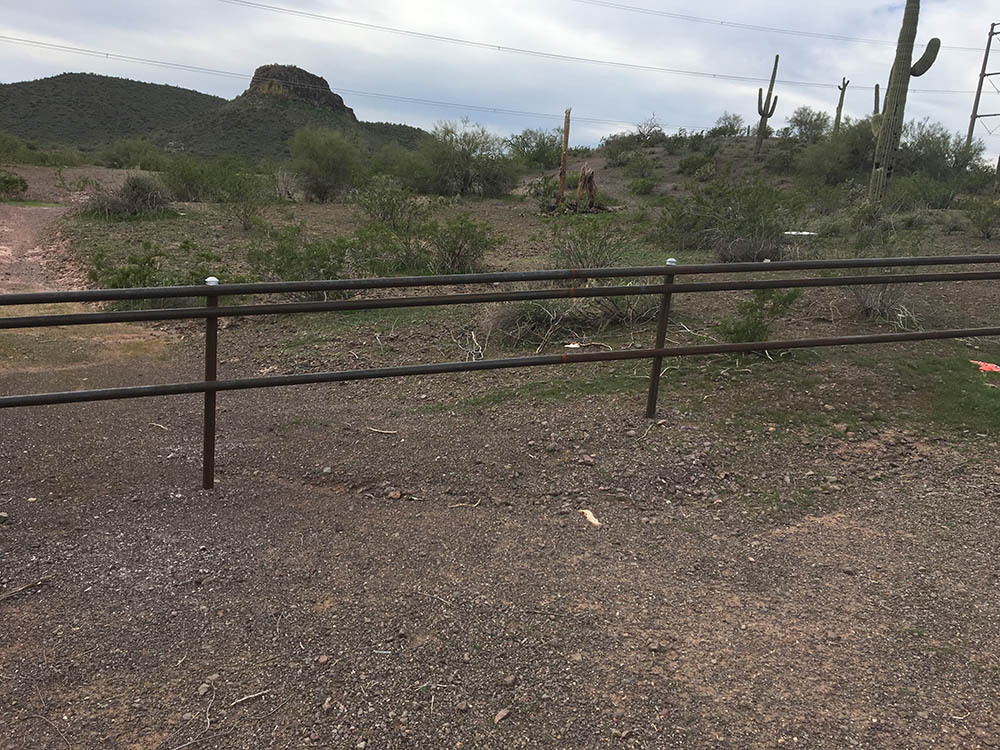
Livestock Fencing in Arizona: Barbed Wire, Woven Wire & Pipe (2026)
Arizona Livestock Fencing Guide
Livestock Fencing in Arizona: Choosing Between Barbed Wire, Woven Wire, Pipe, and Electric
How heat cycling, caliche, monsoon washes, livestock pressure, wildlife, braces, post setting, and access determine what kind of fence actually belongs on Arizona ground.
A fence in Arizona is not asked to do the same job a fence does in Kentucky or Iowa. Here it has to hold stock across ground that can swing more than fifty degrees in a single day, sit in rock, caliche, or loose wash sand, survive monsoon flows that move heavy debris, and stay standing through years of intense sun.
That is why the fence question is never simply what material to use. It is what material, on what post, on what brace, set how deep, across what terrain, and holding what animal. Noland Tough builds livestock and ranch fencing around those site conditions rather than applying one specification to every property.
This guide walks through the fencing types used on Arizona ranch, farm, and rural residential property, what each one is actually good at, and the field details that separate a fence that holds from a fence that only looks like it does.
What Arizona Conditions Do to a Fence
Before choosing a material, it helps to understand the four forces that break fences in this state.
Heat Cycling
Steel wire expands when it heats and contracts when it cools. Seasonal tension changes work against crimps, splices, and especially corner braces.
Ground That Fights the Auger
One line can cross wash sand, decomposed granite, caliche, and fractured rock. Each ground condition calls for a different setting method.
Monsoon Flow
Dry washes can move serious water and debris in a single storm. A fence built straight across drainage without a release plan can become a debris dam.
Wildlife and Stock Pressure
Javelina push under, elk and deer cross over or through, and predators test lower openings around sheep and goats.
Field note from the crew: the most common repair call is often not broken wire. It is an undersized corner or gate brace that has slowly pulled over, taking tension out of every run attached to it.
Choosing the Right Fence for the Animal and the Ground
Barbed Wire
Still the workhorse for cattle on large acreage because it covers ground efficiently, is easy to repair, and holds cattle that respect it.
Four strands are a common baseline. Five strands make sense where pressure is higher, where the line also serves as a property boundary, or where smaller animals need more deterrence.
Woven Wire and Field Fence
The better fit for sheep, goats, calves, and other animals that test the bottom of a strand fence. Fixed-knot fabric holds shape better under sustained pressure than hinged-joint fabric.
Graduated openings keep young stock in while avoiding unnecessarily tight mesh higher up.
Pipe and Continuous Panel
The right material where stock crowd, get worked, wait for water, or move through gates and loading areas.
Pipe belongs in corrals, pens, water areas, entrances, and other high-pressure points where flexible wire is the wrong material.
Electric and Hybrid Systems
Electric works well in Arizona when it is designed for dry ground. More grounding, strategic rod placement, or a hot-and-ground return design may be necessary.
One hot wire offset inside an existing fence is often more useful than relying on electric alone.
Horse Fencing
Horses need different materials because the injury risk is different. Pipe, smooth high-tensile wire, coated wire, and No-Climb-style mesh are common options.
Visibility matters. A fence a horse cannot see is a fence it can run into.
Barbed Wire: Still the Workhorse of Arizona Range
For cattle on large acreage, barbed wire remains the practical default. The material is familiar, repairable in the field, and cost effective across long runs.
Barbed wire is generally the wrong fit for horse pasture, sheep and goats, small residential acreage with children and dogs, and high-traffic areas where stock crowd against the fence.
Woven Wire: When Animals Go Through, Not Over
Sheep, goats, calves, and other small livestock find weaknesses along the bottom of a strand fence. Woven wire solves that problem, but the knot type, opening size, coating, post spacing, and brace design still matter.
Fixed Knot
Holds shape better under sustained pressure than hinged-joint fabric.
Graduated Openings
Tighter lower openings keep young animals in without paying for small mesh everywhere.
Coating Class
Service life matters most around corrals, water, mineral, and manure exposure.
Wind and Debris Load
Mesh catches more wind and debris than strand fence, especially near washes.
Pipe Fence Belongs Where the Pressure Is
Corrals, working pens, water tanks, feeders, loading areas, and gate approaches are where animals concentrate force. Pipe and continuous panel handle that pressure far better than wire.
That is why most well-built Arizona properties are hybrids: pipe at high-pressure points, with wire out on the perimeter where the pressure is lower.
Noland Tough can coordinate fencing with livestock water systems, including tanks, troughs, spring development, solar pumping, and HDPE pipeline.
Electric Fencing: The Grounding Problem Nobody Warns You About
An electric fence completes its circuit through the ground. Dry desert soil is a poor conductor for much of the year, which is why systems that worked well in wetter states can feel weak on Arizona ground.
Electric is especially useful as a hybrid layer that keeps animals from leaning, rubbing, and reaching through an existing barbed or woven-wire fence.
Horse Fencing: A Different Set of Rules
Horses need a fence designed around visibility and injury prevention. Barbed wire that a cow simply backs away from can badly injure a panicked horse.
Pipe Fence
High durability, excellent visibility, and common around arenas, paddocks, and holding areas.
Smooth High-Tensile Wire
Safer than barbed wire and useful for larger turnout areas when paired with a visible top line.
Coated Wire and Mesh
No-Climb-style mesh prevents a hoof from passing through the fence openings.
Combination Builds
Pipe top rail with mesh below combines visibility, strength, and hoof safety.
Comparing the Options
| Fence Type | Best Suited For | Main Strength | Watch Out For |
|---|---|---|---|
| Barbed wire | Cattle, large acreage, perimeter, and range | Covers ground efficiently and is easy to repair | Not appropriate for horses; small stock can go under |
| Woven / field fence | Sheep, goats, calves, predator pressure | Fabric prevents animals from slipping through | Catches wind and debris; needs stronger structural support |
| Pipe / continuous panel | Corrals, pens, water areas, and entrances | Handles sustained pressure and impact | Highest material cost per foot |
| Electric hybrid | Rotation and protecting an existing fence | Changes animal behavior and extends fence life | Dry-soil grounding must be designed correctly |
| Smooth wire / mesh | Horses and mixed livestock | Safer for horses with good hoof protection | Needs visibility and correct tensioning |
Corners and Braces: Where Fences Actually Fail
Every fence is a tension system, and every tension system is only as good as what it pulls against. The corner, end, and gate assemblies carry the accumulated load of the whole run.
Brace Length
A horizontal brace that is too short can pivot the post instead of spreading the load correctly.
Depth
Corner and gate posts generally go deeper than line posts, especially in loose or sandy soil.
Diagonal Wire Direction
The diagonal must run in the direction that actually resists the fence tension.
Double Bracing
Long pulls, rolling ground, and sharp direction changes can justify additional bracing.
Caliche as an Asset
A brace post properly set into and below hard caliche can be extremely difficult to pull.
Post Selection and Setting in Arizona Ground
The post is the connection between the fence and the ground, and Arizona ground can change several times within a single fence run.
| Ground Condition | What It Means for Setting | Typical Approach |
|---|---|---|
| Hard caliche layer | Standard auger can stall and holes become slow | Rock auger, breaker, or driven post; set into and below the layer |
| Fractured rock | Hole size and shape can be unpredictable | Driven post where possible; footing where not |
| Loose wash sand | Post has little lateral support | Greater depth, larger footing, and potentially closer spacing |
| Expansive clay | Ground moves seasonally | Depth below the active zone with correct backfill and compaction |
| Mixed transitions | Method needs to change mid-run | Assess by section instead of specifying one setting method for the whole line |
Steel T-posts are efficient line posts on many range fences. Pipe belongs at corners, gates, and other high-pressure points. Wood can still work, but Arizona sun, ground contact, and termite exposure make treatment and placement important.
Gates, Cattle Guards, and Access Points
Gate Width
Size the opening for the largest equipment that will ever need to pass through it.
Gate Posts
These are brace posts, carrying gate weight and fence tension at the same time.
Cattle Guards
Useful where traffic is constant and a conventional gate is likely to be left open.
Wing Fencing
Short angled sections guide animals away from the edges of a cattle guard or access opening.
Washes, Drainage, and Wildlife Crossings
A fence run straight across an active wash becomes a debris collector. Brush stacks against the wire, water backs up, and the entire crossing can fail.
Water Gaps
A section designed to swing, hang, or lay down under flow and be reset afterward.
Drop Panels
Suspended or hinged sections that can lift when water and debris rise.
Anchored Crossings
Heavier construction with deep-set posts on both banks where the flow path is predictable.
Wildlife-Friendly Spacing
Smooth lower wires and appropriate top-wire heights reduce wildlife injury and repeated fence damage.
Fence and water planning should be handled together. Strategic fencing changes where cattle can travel to drink, while livestock water infrastructure makes exclusion fencing and grazing rotation practical.
What Drives a Fencing Project Up or Down
Total Footage
Longer straight runs become more efficient until terrain or direction changes interrupt the workflow.
Terrain and Access
Flat truck-accessible ground is a different project from a hillside that materials must be carried into.
Ground Conditions
Rock and hard caliche dramatically change the time and equipment required for post setting.
Corners and Gates
Every direction change creates a brace assembly where labor and material are concentrated.
Material and Coating
Gauge, knot type, coating class, and pipe versus wire affect both price and service life.
Demolition and Haul-Off
Pulling old fence, rolling wire, removing posts, and hauling material away needs its own scope.
Drainage Structures
Water gaps and wash crossings are specialty sections rather than ordinary line fence.
Travel and Remoteness
Moving crews, tools, and material to distant ground is part of the project.
For locations beyond vehicle access, Noland Tough can coordinate pack-animal material transport and other remote-access methods as part of the build.
What a Complete Fencing Quote Should Spell Out
Maintenance: The Schedule That Doubles Fence Life
A fence is a tension system working in a harsh environment. The properties with the best fence are usually the ones that inspect on a rhythm instead of waiting for an escape.
Before Monsoon Season
- Clear brush and debris from washes and water gaps.
- Confirm drop panels and hinged sections still move freely.
- Check that gates latch and swing without dragging.
After Significant Storms
- Inspect drainage crossings first.
- Look for undercut posts and scour around footings.
- Reset water gaps before livestock find the opening.
Twice a Year
- Re-tension slack runs while accounting for temperature.
- Inspect every corner and gate brace for lean or base movement.
- Check bottom wires along wildlife travel routes.
- Test electric voltage at the far end of the run.
Annually
- Inspect coating near water, mineral, and feeding areas.
- Check wood posts at ground line.
- Reassess whether the fence still matches how the property is being used.
Frequently Asked Questions
What type of fence is best for livestock in Arizona?
It depends on the animal and the job. Cattle on open range commonly use barbed wire. Sheep, goats, and calves are better suited to woven wire. Horses need smooth wire, pipe, or coated mesh. Corrals and working pens are typically pipe or continuous panel.
How far apart should fence posts be for livestock fencing?
Spacing depends on fence type, terrain, ground condition, wire tension, wildlife, and livestock pressure. Rocky terrain, wash crossings, and high-pressure areas often require tighter spacing or heavier construction.
Can you build fence in caliche?
Yes. Hard caliche changes the equipment and method. Rock augers, breakers, or driven posts may be used depending on the layer. Once a post is properly set into and below a hard caliche layer, that layer can provide excellent resistance to pullout.
Does barbed wire need to be tighter or looser in Arizona heat?
Wire changes tension as temperature changes. Experienced crews tension to a target rather than by feel and account for the temperature and season on the day the wire is pulled.
Why does my electric fence work elsewhere but not on my Arizona property?
Dry-soil grounding is usually the issue. More ground rods, better rod placement, or a hot-and-ground return system can improve performance where the soil does not provide a reliable return path.
What is the difference between field fence and woven wire?
The terms overlap. The important specifications are opening size, wire gauge, knot type, and coating. Fixed-knot fabric generally holds shape better under sustained animal pressure.
How long should a new fence last in Arizona?
Service life depends heavily on brace design, post setting, coating, drainage exposure, and maintenance. A properly built and regularly inspected fence can remain functional for many years.
What drives the price of a fencing project up or down?
The main variables are footage, terrain, access, rock and caliche, corners and gates, material type and coating, demolition, drainage structures, and travel required to reach the work.
Do I need gates and cattle guards, or can I get by with just gates?
Gates are simpler for occasional access. Cattle guards make sense where traffic is frequent and a gate would predictably be left open. Many working properties use both.
Can you fence across a wash?
Yes, but the crossing needs to be designed for flow and debris. Water gaps, drop panels, hinged sections, and anchored crossings are common strategies.
Build Fence That Belongs on This Ground
The fences that last in Arizona are built by people who understand the ground, the animal, the tension system, and the water moving across the property. Material matters, but method matters more.
Noland Tough works across Arizona ranch, farm, and rural property on fencing, livestock water infrastructure, packing and remote access, and licensed vegetation treatment.
Send us the property details and what you need to contain, or have us walk the ground with you. The important decisions on an Arizona fence line are usually made standing on the line, not from a desk.
Discuss Your Fencing Project Call 928-322-3658
Noland Tough Fence and Ranch Infrastructure, Humboldt, AZ.
Serving Arizona ranches, farms, landowners, agencies, and remote properties.
AZ ROC #271421 | Custom Applicator License #453
“No job is too rough or remote.”